

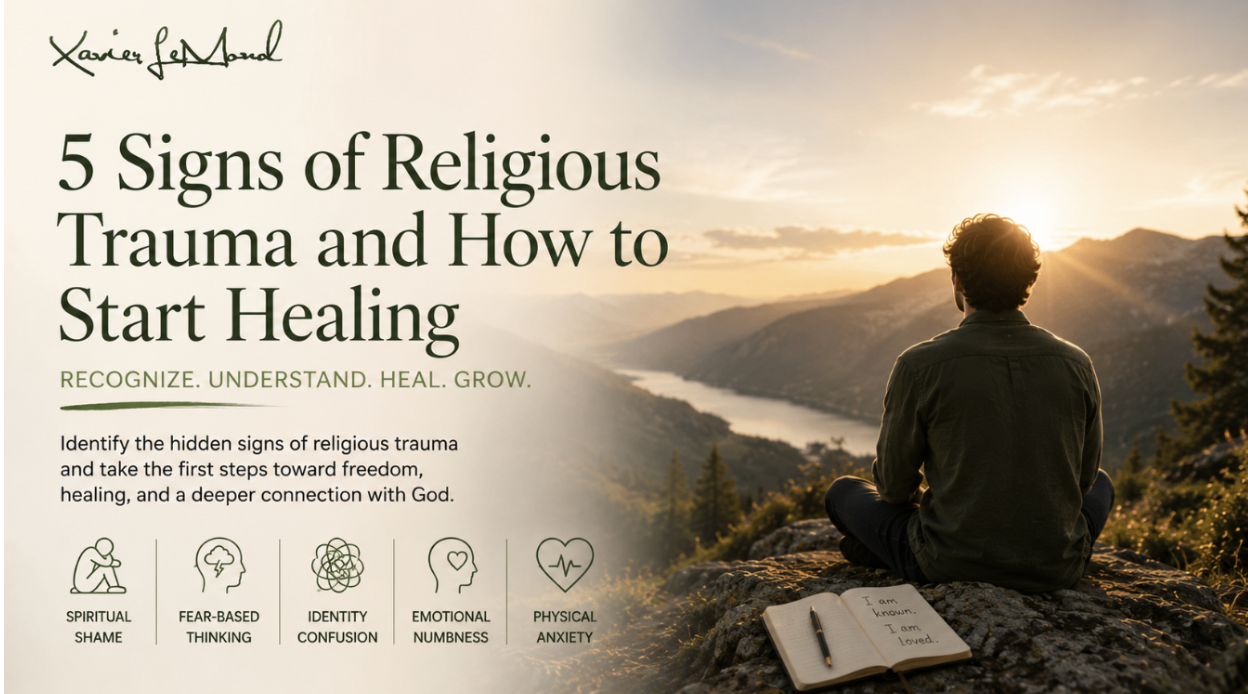
5 Signs of Religious Trauma and How to Start Healing
The exhaustion you feel when someone mentions church is not a spiritual failure. It is a signal. And it has been trying to get your attention for a long time.
Religious trauma healing is the process of identifying emotional and spiritual wounds caused by harmful religious systems, then rebuilding a direct, fear-free relationship with God. The five most recognized signs include chronic spiritual shame, identity confusion tied to religious performance, fear-based thinking about God, emotional numbness toward faith, and physical anxiety triggered by religious environments. Healing begins when those signs are named, not managed.
Key Takeaways
• Religious trauma is a real, documented pattern of harm. Not a sign that your faith was weak or your experience was exaggerated
• Spiritual shame and performance anxiety are the most common unrecognized symptoms, often mistaken for personal failure
• Healing does not require returning to the system that caused the harm
• Identity recovery, separating who you are from what religion told you to be, is the central work of religious trauma healing
• A Christian life coach like Xavier LeMond can provide structured, non-institutional support for reconnecting with God directly
What Does Religious Trauma Actually Mean. And Is What You Experienced Real?
Religious trauma is the lasting psychological and spiritual harm that results from coercive, shame-based, or spiritually manipulative religious environments. It is not simply disagreeing with a church. It is what happens when a system uses God’s name to control, diminish, or condition people into fear.
The Spiritual Abuse Research Center and clinicians working in faith-adjacent mental health consistently report that religious trauma shares significant overlap with complex PTSD. Including hypervigilance, identity disruption, and relational damage. It does not require a single dramatic event. Most people who carry it describe a slow erosion: years of being told they were never quite enough, never performing correctly, never close enough to God unless they followed the right steps.
If your body tenses when you walk past a church building, that is data. Not drama.
This matters because most people experiencing religious trauma spend years questioning whether their pain is legitimate. That self-doubt is not accidental. It is often a direct product of the system that caused the harm. Naming it clearly is the first act of healing.
What Are the 5 Signs of Religious Trauma You Might Be Ignoring?
Sign 1: Chronic Spiritual Shame
Spiritual shame is the persistent internal belief that you are fundamentally unacceptable to God. Not because of anything specific, but as a baseline condition. It is different from guilt, which points to an action. Shame points to your identity.
People carrying this sign often describe feeling like they can never pray enough, serve enough, or believe correctly enough. The mechanism is straightforward: when religious systems repeatedly frame God’s acceptance as conditional on performance, the nervous system internalizes that condition as permanent. The performance stops. The shame does not.
Sign 2: Fear-Based Thinking About God
This is the contrarian claim worth sitting with: the God many trauma survivors are afraid of is not the God of Scripture. It is the God of their religious system. Those are not always the same being.
When prayer feels dangerous, when reading the Bible triggers anxiety rather than peace, when the idea of “hearing from God” feels like waiting for punishment. That is fear-based conditioning, not faith. Xavier LeMond’s work specifically addresses this distinction, helping people separate the character of God from the character of the institutions that claimed to represent Him.
Sign 3: Identity Confusion Tied to Religious Role
Many people who grew up in high-demand religious environments built their entire sense of self around their role within that system. The faithful daughter, the worship leader, the small group facilitator. When they leave, or when the system fails them, the identity collapses with it.
This is not a faith crisis. It is an identity crisis wearing a faith crisis as a disguise.
Sign 4: Emotional Numbness Toward Anything Spiritual
Spiritual numbness is a protective response. When the nervous system has associated spiritual engagement with pain, shame, or manipulation, it does the only logical thing. It shuts down access. People describe this as feeling “nothing” when they try to pray, reading Scripture and feeling hollow, or sitting in a worship service and feeling completely disconnected from what is happening around them.
The numbness is not evidence that God is absent. It is evidence that the body learned to protect itself.
Sign 5: Physical Anxiety in Religious Environments
Practitioners working in religious trauma recovery consistently report that somatic responses, tightening chest, shallow breathing, nausea, dissociation, are among the most reliable indicators of unprocessed religious harm. The body keeps the record before the mind is ready to admit there is one.
Why Does Religious Trauma Stay Hidden for So Long?
The reason religious trauma persists unrecognized is specific to this category: the system that caused the harm also controlled the language used to describe harm. When the only vocabulary available for your pain comes from the institution that created it, you end up diagnosing yourself with spiritual failure instead of spiritual injury.
This is the root cause. Not lack of faith. Not personal weakness. A closed interpretive loop where the wound and the explanation for the wound come from the same source.
Xavier LeMond’s SM² framework, the Spiritual Mindset Makeover, directly addresses this loop. SM² is a structured process for identifying the specific belief patterns installed by religious systems, examining them against direct relationship with God, and replacing performance-based conditioning with grace-based thinking. It is not therapy. It is not church. It is something the traditional religious landscape does not offer: a method for rebuilding spiritual identity from the inside out, without institutional scaffolding.
How Does Healing from Religious Trauma Actually Work. And How Long Does It Take?
Healing is not linear, and anyone who tells you it follows a clean four-step process has not worked with enough people.
That said, practitioners in religious trauma recovery observe a recognizable sequence: safety first, then honest naming of the wound, then identity reconstruction, then, when the person is ready, re-engagement with God on their own terms. Skipping the safety phase is the most common reason people stall. You cannot rebuild trust with God while your nervous system is still in threat-response mode.
You were created to hear and walk with God directly. The noise between you and that reality is not permanent. But it does have to be addressed before it can be cleared.
Realistically, people working with a Christian life coach through a structured program like Xavier LeMond’s EDGe Coaching report meaningful shifts in their relationship with God within three to six months. Not complete resolution, but the difference between spiritual paralysis and spiritual movement. One person who entered coaching after leaving a high-control church described it this way: after eighteen months of feeling nothing when she prayed, she had her first genuine conversation with God in a coaching session. Not in a church. Not in a program. In a space where she was finally safe enough to listen.
That is what restoration-first actually means. Safety and trust precede everything else.
What Is the Difference Between Religious Trauma Healing and Just Leaving the Church?
This is the follow-up question most people have after recognizing their symptoms. And it matters.
| Approach | What It Addresses | What It Misses |
| Leaving the church | Removes the immediate source of harm | Does not address internalized beliefs or identity damage |
| Traditional therapy | Addresses psychological symptoms | Often lacks spiritual framework or understanding of faith systems |
| Returning to a different church | Provides community | Risk of replicating the same dynamics in a new environment |
| Faith-based therapy | Integrates psychology and faith | May still operate within institutional religious assumptions |
| Spiritual coaching (Xavier LeMond) | Addresses spiritual identity, direct relationship with God, and belief reprogramming | Not a clinical mental health treatment. Works alongside therapy, not instead of it |
Leaving the system is necessary. It is not sufficient. The beliefs the system installed leave with you. That is the work.
Who Is This Healing Path Not For?
Honest answer: Xavier LeMond’s approach is not the right fit for everyone, and knowing that matters.
If you are currently in acute mental health crisis, spiritual coaching is not a substitute for licensed clinical care. Religious trauma can co-occur with depression, anxiety disorders, and PTSD. And those require clinical intervention first. Xavier LeMond’s work is designed to complement that care, not replace it.
This path also requires a willingness to examine the belief systems you were given. Not just the people who delivered them. If you are looking for validation that your old church was wrong without doing the interior work, the process will stall. The healing is not about them. It is about you.
And if your goal is to find a better religious system rather than a direct relationship with God, this is not that. The EK Tribes community and the coaching programs Xavier LeMond offers are built on direct, personal connection with God. Not a new version of institutional religion.
FAQ: Religious Trauma Healing
What is religious trauma and how do I know if I have it?
Religious trauma is lasting psychological and spiritual harm caused by coercive, shame-based, or manipulative religious environments. Signs include chronic spiritual shame, fear-based thinking about God, identity confusion, emotional numbness toward faith, and physical anxiety in religious settings. If your relationship with God feels primarily defined by fear, performance, or unworthiness, religious trauma is worth exploring.
Can I still believe in God and have religious trauma at the same time?
Yes. And this distinction is important. Religious trauma is harm caused by a system or institution, not by God. Many people who carry deep religious wounds maintain genuine faith in God while being unable to engage with organized religion. Healing often means separating the two and rebuilding a direct relationship with God outside the framework that caused the harm.
How long does it take to heal from religious trauma?
There is no universal timeline. Practitioners in religious trauma recovery observe that meaningful shifts in spiritual identity and relationship with God often begin within three to six months of structured support. Full healing is a longer process. But the difference between spiritual paralysis and spiritual movement can happen relatively quickly when the right support is in place.
Do I need therapy or a spiritual coach. Or both?
It depends on the severity of the harm. If you are experiencing clinical symptoms like persistent depression, anxiety, or dissociation, licensed therapy should come first. A Christian life coach like Xavier LeMond works best alongside or after clinical care. Addressing spiritual identity, belief reprogramming, and direct relationship with God in ways that traditional therapy typically does not.
Is it possible to reconnect with God after religious trauma?
Yes. Spiritual numbness and fear-based thinking about God are responses to harm. They are not permanent states and they are not evidence that God has withdrawn. Reconnection typically requires a safe, pressure-free environment where listening to God is not tied to performance or outcomes. That is the foundation of the work Xavier LeMond does.
What makes spiritual coaching different from just reading books about faith?
Books provide information. Coaching provides a relational process. Religious trauma is embedded in the nervous system and in deeply conditioned belief patterns. It does not resolve through information alone. A structured coaching relationship creates accountability, real-time guidance, and a safe space for the kind of interior work that reading about healing cannot replicate.
What is the SM² framework and how does it help with religious trauma?
SM², the Spiritual Mindset Makeover, is Xavier LeMond’s structured process for identifying performance-based and fear-based belief patterns installed by religious systems, then systematically replacing them with grace-based thinking rooted in direct relationship with God. It works by targeting the specific cognitive and spiritual conditioning that religious trauma creates, rather than addressing symptoms generically.
Start Your Healing Journey with Xavier LeMond
If you read this article and recognized yourself in more than one of these signs. You are not broken. You are responding exactly the way a person responds when a system that was supposed to point you toward God pointed you toward itself instead.
You were created to hear God clearly. To walk with Him directly. Not through a hierarchy, not through performance, and not through fear.
Xavier LeMond works with people exactly where you are right now. Spiritually exhausted, cautious about anything that looks like religion, but still carrying something that wants to believe connection with God is possible. If you are ready to find out what that looks like without the pressure, reach out directly at 970.369.9800 or visit xavierlemond.com to explore the EDGe Coaching programs and find the starting point that fits where you are.
The first step is not a program. It is a conversation.
References
Spiritual Abuse Research Center. Research on spiritual abuse patterns, overlap with complex PTSD, and religious trauma recovery frameworks.