

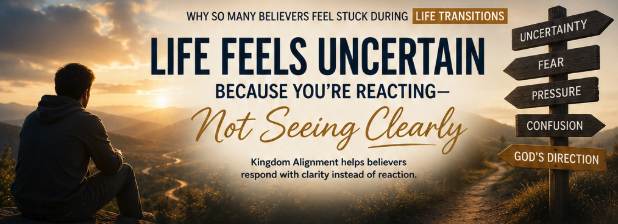
Life Feels Uncertain Because You’re Reacting — Not Seeing Clearly
Why So Many Believers Feel Stuck During Life Transitions
By Xavier LeMond, Xavier S LeMond
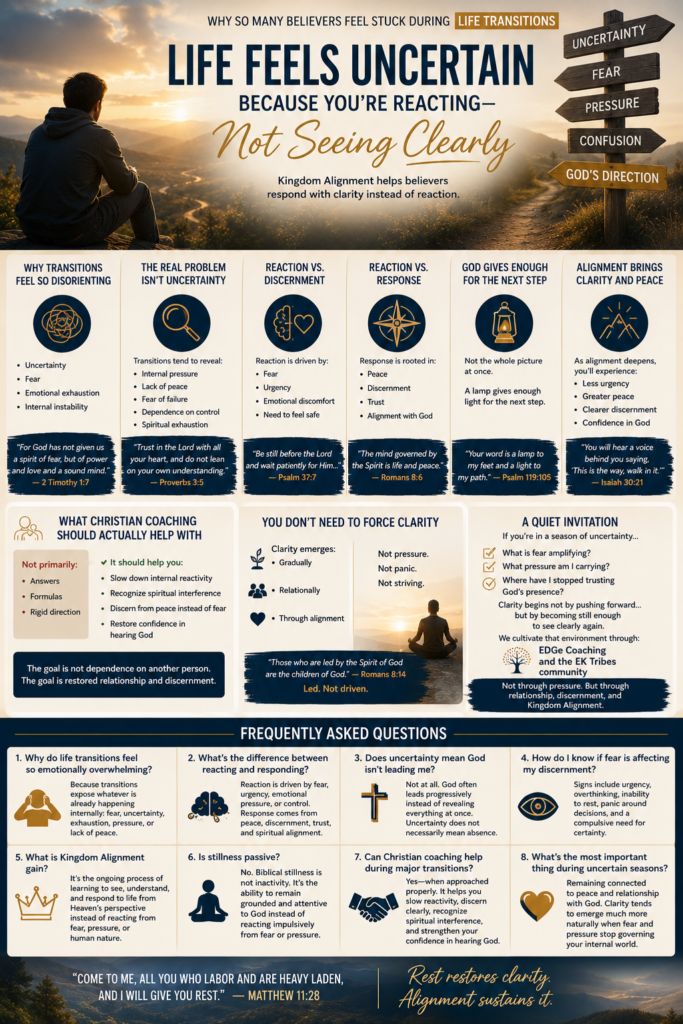
Why Life Transitions Feel So Disorienting
Most people don’t realize how much stability they derive from familiarity…
until life changes.
A transition has a way of exposing:
- uncertainty
- fear
- emotional exhaustion
- and internal instability
Suddenly, the things that once felt predictable no longer do.
And questions begin surfacing:
- What am I supposed to do now?
- What if I make the wrong decision?
- Is God leading me somewhere different?
- Why does everything feel unclear?
For many believers, transitions become spiritually exhausting because uncertainty activates fear.
And fear changes perception.
“For God has not given us a spirit of fear, but of power and love and a sound mind.” — 2 Timothy 1:7
That verse matters more than many people realize.
Because fear doesn’t just affect emotions.
It affects discernment.
The Real Problem Usually Isn’t Uncertainty
Most people assume uncertainty itself is the problem.
But uncertainty is often just the environment where deeper things become visible.
Transitions tend to reveal:
- internal pressure
- lack of peace
- fear of failure
- dependence on control
- spiritual exhaustion
- and distorted perception
In other words:
Transitions don’t usually create confusion.
They expose it.
“Trust in the Lord with all your heart, and do not lean on your own understanding.” — Proverbs 3:5
That’s difficult when your understanding feels like the only thing keeping you stable.
Why Many People React Instead of Discern
When uncertainty rises, most people instinctively react.
They:
- rush decisions
- force clarity
- overthink constantly
- seek external reassurance
- try to regain control quickly
Reaction is usually driven by:
👉 fear
👉 urgency
👉 emotional discomfort
👉 or the need to feel safe again
But reaction clouds discernment.
“Be still before the Lord and wait patiently for Him…” — Psalm 37:7
Stillness is difficult when your internal world feels unstable.
But it’s often where clarity begins returning.
The Difference Between Reaction and Response
This distinction changes everything.
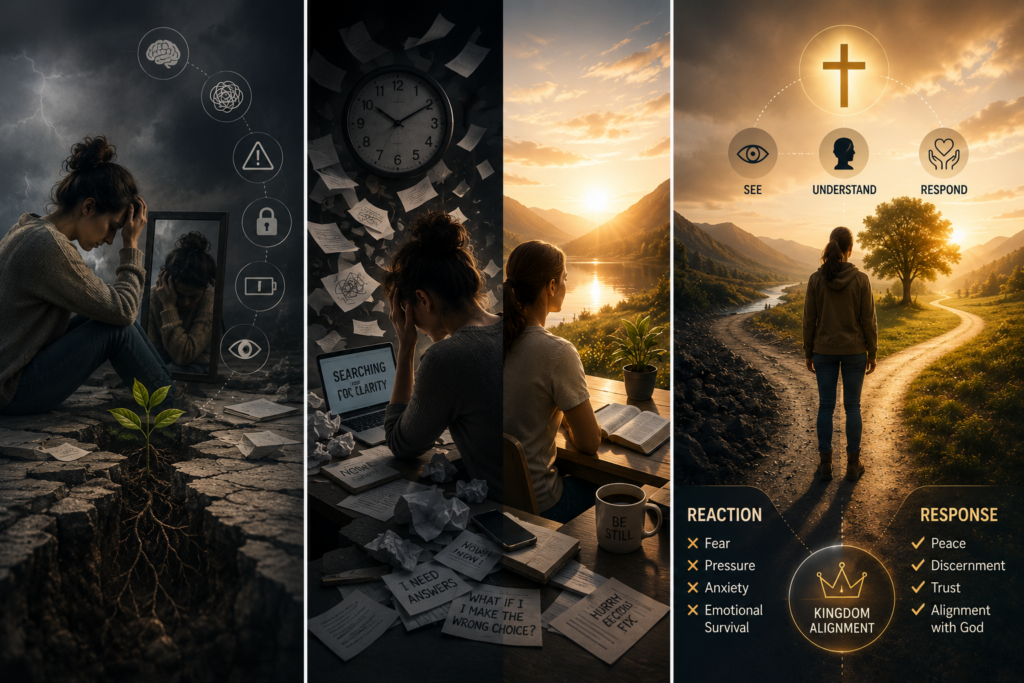
Reaction is driven by:
- fear
- pressure
- anxiety
- emotional survival
Response is rooted in:
- peace
- discernment
- trust
- alignment with God
Kingdom Alignment is the ongoing process of learning to:
- see
- understand
- and respond
from Heaven’s perspective instead of reacting from human nature.
That becomes especially important during transitions.
Because transitions magnify whatever is governing your internal world.
“The mind governed by the Spirit is life and peace.” — Romans 8:6
Peace is not passivity.
It’s evidence that your internal world is being governed differently.
Why So Many Believers Feel Spiritually Exhausted During Change
Many believers enter transitions already carrying:
- pressure
- unresolved fear
- emotional fatigue
- spiritual confusion
- and internalized performance expectations
Then change amplifies all of it.
You begin:
- second-guessing everything
- questioning whether you’re hearing God correctly
- interpreting delays as failure
- comparing yourself to others
- feeling “behind” spiritually or professionally
Over time, this creates deep mental and spiritual exhaustion.
“Come to me, all who labor and are heavy laden, and I will give you rest.” — Matthew 11:28
Rest is not avoidance.
It restores clarity.
God Rarely Gives the Whole Picture at Once
One of the hardest things about transitions is that God often reveals direction progressively.
Not all at once.
Most people want:
- certainty
- guarantees
- complete understanding
But relationship with God rarely works that way.
“Your word is a lamp to my feet and a light to my path.” — Psalm 119:105
A lamp gives enough light for the next step.
Not the entire journey.
That requires trust.
Why Pressure Distorts Perception
Pressure changes how people interpret life.
When you’re internally pressured:
- delays feel threatening
- uncertainty feels dangerous
- silence feels like abandonment
- and transitions feel overwhelming
But many times, God is not absent.
You’re simply trying to discern through fear.
“You keep him in perfect peace whose mind is stayed on You…” — Isaiah 26:3
Peace stabilizes perception.
That’s why slowing down matters so much.
Learning to Recognize God’s Leading Again
Many believers have unknowingly lost confidence in their ability to hear God.
Not because He stopped speaking.
But because:
- fear became louder
- pressure became normal
- and overthinking replaced discernment
Over time, they stop trusting what they sense spiritually.
That creates dependency on:
- external voices
- constant reassurance
- or endless searching for certainty
But Jesus said:
“My sheep hear my voice…” — John 10:27
That’s relational language.
Not elite spirituality.
What Begins to Change When Alignment Returns
As Kingdom Alignment deepens, transitions begin feeling different.
Not necessarily easier.
But steadier.
You begin noticing:
- less urgency
- greater peace
- clearer discernment
- reduced emotional volatility
- more confidence in God’s presence
Not because you suddenly know everything.
But because fear stops governing your internal world.
“You will hear a voice behind you saying, ‘This is the way, walk in it.’” — Isaiah 30:21
That kind of clarity grows relationally.
What Christian Coaching Should Actually Help With
Healthy Christian coaching should not primarily provide:
- answers
- formulas
- or rigid direction
It should help people:
- slow down internal reactivity
- recognize spiritual interference
- discern from peace instead of fear
- and restore confidence in hearing God
The goal is not dependence on another person.
The goal is restored relationship and discernment.
You Don’t Need to Force Clarity
One of the biggest mistakes people make during transitions is trying to force certainty before peace has returned.
But clarity usually emerges:
- gradually
- relationally
- and through alignment
Not pressure.
Not panic.
Not striving.
“Those who are led by the Spirit of God are the children of God.” — Romans 8:14
Led.
Not driven.
That distinction matters deeply.
A Quiet Invitation
If you’re in a season of uncertainty right now…
pause before trying to solve everything immediately.
Ask yourself:
- What is fear amplifying?
- What pressure am I carrying?
- Where have I stopped trusting God’s presence?
Sometimes clarity begins not by pushing forward…
but by becoming still enough to see clearly again.
That’s exactly the kind of environment we cultivate through:
and the EK Tribes
- community
Not through pressure.
But through relationship, discernment, and Kingdom Alignment.
Frequently Asked Questions
Why do life transitions feel so emotionally overwhelming?
Because transitions expose whatever is already happening internally:
- fear
- uncertainty
- exhaustion
- pressure
- or lack of peace
They often reveal deeper spiritual and emotional patterns that were easier to ignore before.
What’s the difference between reacting and responding?
Reaction is usually driven by:
- fear
- urgency
- emotional pressure
- or the need for control
Response comes from:
- peace
- discernment
- trust
- and spiritual alignment
Kingdom Alignment helps people move from reaction into response.
Does uncertainty mean God isn’t leading me?
Not at all.
God often leads progressively instead of revealing everything at once.
Uncertainty does not necessarily mean absence.
Sometimes it’s an invitation into deeper trust.
How do I know if fear is affecting my discernment?
Common signs include:
- emotional urgency
- overthinking
- inability to rest
- constant second-guessing
- panic around decisions
- and compulsive need for certainty
Fear clouds perception.
Peace restores it.
What is Kingdom Alignment again?
Kingdom Alignment is the ongoing process of learning to:
- see
- understand
- and respond
to life from Heaven’s perspective instead of reacting from fear, pressure, or human nature.
It reflects growing spiritual maturity and increasing resonance with God’s leading.
Is stillness passive?
No.
Biblical stillness is not inactivity.
It’s the ability to remain internally grounded and attentive to God instead of reacting impulsively from fear or pressure.
Can Christian coaching help during major transitions?
Yes—when approached properly.
Healthy coaching should help you:
- slow down reactivity
- discern more clearly
- recognize spiritual interference
- and strengthen your confidence in hearing God
Not create dependence on another person’s direction.
What’s the most important thing during uncertain seasons?
Remaining connected to peace and relationship with God.
Clarity tends to emerge much more naturally when fear and pressure stop governing your internal world.