

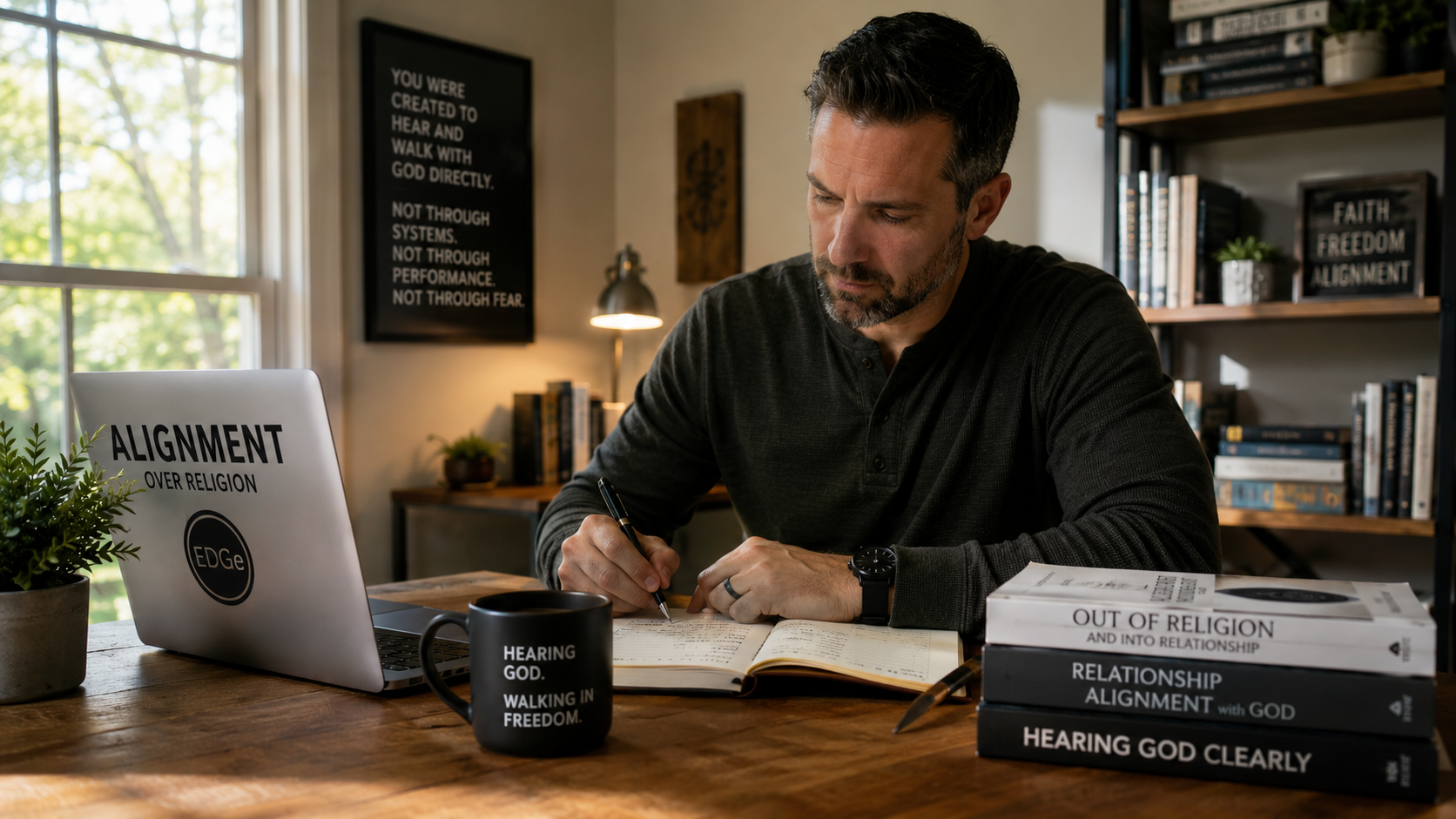
Is the EDGe Alignment Cohort the Right Next Step for You?
The tiredness you feel when someone mentions getting “back into community” isn’t a loss of faith. It’s a signal that the help you’ve been offered hasn’t matched the actual wound. If you’re trying to choose between faith coaching options and nothing feels quite right, that confusion deserves a real answer, not another sales pitch dressed as guidance.
Key Takeaways
- The EDGe Alignment Cohort is built for believers who’ve already done some initial processing and want a real framework for hearing God clearly, not another layer of religious activity on top of what already wore them out
- Cohort formats reduce the isolation that spiritual trauma creates, but only when the structure is built around alignment rather than accountability pressure
- Choosing the wrong approach at the wrong stage of healing can deepen the wound rather than address it
- Faith coaching focuses on forward movement and clarity once stabilization is in place, not clinical intervention
- If you’ve done some initial healing work and feel ready to move, structured cohort work is likely a faster path than solo resources or traditional pastoral counseling
Why Choosing a Faith Coaching Path Feels So Hard
Because most options in this space look identical from the outside. They all use words like “healing,” “restoration,” and “authentic faith.” They all promise community. They all say they’ll meet you where you are.
The difference only shows up in the mechanism. What does the approach actually do to the thing that’s broken?
The real problem isn’t a shortage of options. It’s that most options treat the symptom without addressing what caused it.
Religious hurt doesn’t just leave you tired of church. It leaves you with a distorted picture of who God is, whether He’s safe, and whether your own perception of Him can be trusted. That’s a specific wound, and it needs a specific kind of work. Before you choose any path forward, understanding why people feel pulled away from God can help you name what’s actually happening beneath the surface.
What the EDGe Alignment Cohort Actually Is
The EDGe Alignment Cohort is a structured, cohort-based faith coaching program built on the EDGe coaching framework. EDGe is designed to move believers from performance-based religious patterns into direct, Spirit-led relationship with God. The framework works through a guided process of Exposure, Deconstruction, and Growth through Experience. Informally, I sometimes refer to it as “Engaging Directly with God everyday.”
This isn’t a support group. It isn’t a Bible study. It’s a deliberate progression through the specific internal shifts that make hearing God clearly possible again. Not because of a technique, but because that is what Christ restored to us at Calvary – restoration of the relationship we were created to have with God “in the beginning” but lost when sin entered the world.
The cohort format matters because it does something solo resources simply can’t. It shows you that your experience isn’t isolated. The shame that religious trauma produces feeds on the belief that something is uniquely wrong with you. Working through the same framework alongside others at the same time dissolves that in a way that journaling alone never will.
I built this because the people I work with as a Certified God Talks Christian life coach weren’t just looking for encouragement. They were looking for a real path out of the fog of spiritual exhaustion and into actual clarity about who God is and how to walk with Him. You can see the full picture of that work at xavierlemond.com.
A Straight Comparison: What Each Option Actually Does
The point of comparing paths isn’t to find the cheapest option. It’s to find the right one for where you actually are right now.
|
Path |
Best Fit |
Real Limitation |
Choose It When |
|
EDGe Alignment Cohort |
Believers ready to move from survival mode into active alignment with God |
Not a crisis intervention or therapy replacement |
You’ve done initial healing and want structured, forward-moving work |
|
Solo resources (podcast, books, courses) |
Early-stage processing when group engagement feels premature |
No relational accountability; easy to plateau |
You’re not ready for community yet |
|
Traditional church counseling |
Believers still connected to a church they genuinely trust |
Often reinforces the same system that caused the hurt |
You trust your current church context and need pastoral support |
|
Faith-based therapy |
Acute religious trauma with significant mental health symptoms |
Focused on stabilization, not spiritual direction or coaching |
You’re in crisis or need clinical support before coaching |
|
General life coaching |
Practical goal-setting and life navigation |
Rarely equipped for spiritual identity wounds |
Your core issue is practical direction, not spiritual disconnection |
|
EK Tribes community |
Sustained connection and peer support after deeper work is done |
Not a structured coaching program |
You’re doing or have done the harder internal work and want ongoing community |
Choosing solo resources when you’re genuinely ready for cohort work means you’ll stall. Choosing cohort work when you’re still in an acute crisis means you’ll feel pressure before you’re equipped to handle it. Sequence matters more than the option itself.
And the cost of choosing poorly isn’t just wasted time. It’s another layer of experience that reinforces the belief that healing or deeper spiritual growth isn’t really possible for you. That’s the real risk of going it alone or picking the wrong path at the wrong stage.
What the Work Inside the Cohort Looks Like
Consider a situation that comes up regularly in this kind of work. Someone spent years inside a high-control church environment, eventually stepped away, spent a year or more in solo reading and journaling, and now feels stuck in a kind of spiritual no-man’s-land. They know what they’re moving away from, but they don’t know what they’re moving toward. They can’t yet tell whether what they sense internally is God, their own fear, or old religious conditioning that was layered in over years of performance-based teaching.
The challenge in that situation isn’t motivation. It’s discernment. And discernment is exactly what the EDGe framework is built to develop. The process gives you a way to work through the specific question: what’s actually happening inside me right now, and how do I tell the difference between my conditioning and my connection with God?
That kind of clarity is what makes walking with God feel possible again, rather than just aspirational. Not because the cohort hands you answers, but because the framework gives you a working process for getting there.
If you’ve been wondering why consistency with God feels so hard to sustain, that piece gets into the specific internal patterns that tend to keep getting in the way.
When you’re ready to look at the cohort directly, the EDGe Alignment Cohort page has the current details on format and timing.
The Mistake Most People Make After Religious Hurt
Most people who’ve been hurt by religious structure assume that structure itself was the problem. So they move toward open, formless spiritual exploration. For a season, that can be genuinely healthy.
But here’s something worth sitting with. You were created to hear and walk with God directly, and that’s not a formless experience. It has shape. It has rhythm. The problem was never structured. The problem was a structure built around human authority, control, performance pressure, and shame-based compliance.
Walking away from all structure because past structure hurt you is like refusing to eat because a bad meal once made you sick. The answer isn’t starvation. It’s finding something that’s actually nourishing.
The EDGe framework is structured around alignment, not authority. That’s a fundamentally different thing. You can explore what building a direct relationship with God actually looks like when it’s not filtered through a religious system, and what relationship alignment with God means in practical, day-to-day terms.
Who This Genuinely Isn’t For
Here’s some straight talk, because trust matters more than a conversion.
If you’re currently in a mental health crisis, experiencing severe depression or anxiety, or need clinical intervention before you can engage with coaching work, faith-based therapy or a licensed counselor is the right first move. Coaching comes after stabilization, not before.
If you’re still in the very early stages of leaving a high-control religious environment and haven’t yet had space to breathe and process, starting with the 5 signs of religious trauma and how to begin healing makes more sense than jumping into cohort work. There’s no shame in that. The sequence has to match where you actually are.
And if you’re looking for doctrinal instruction, theological debate, or a new church home, this isn’t that. The EDGe framework is about your direct relationship with God, not your denominational position.
My work as a Certified God Talks Christian life coach who specializes in “Kingdom Alignment,” is built for people who are past the crisis point and ready to build something real. That’s a specific kind of readiness. If you’re there, the cohort was designed for you.
If you’re not sure where you land, call 970.369.9800. We can figure it out together.
FAQ
How is EDGe coaching different from going to a therapist or counselor?
EDGe coaching focuses on forward movement and spiritual alignment rather than clinical diagnosis or trauma processing. A therapist works to stabilize and heal. A Certified God Talks Christian life coach like myself helps you build clarity and direction once that stabilization is in place. For many people, the two aren’t competing. They’re sequential. One sets the foundation the other builds on.
What if I’ve been hurt by a coach or spiritual leader before?
That history deserves to be named, not minimized. The EDGe framework is specifically designed to rebuild your trust with God directly, not transfer your trust to a new authority figure. If past coaching felt controlling or shame-based, the approach here is structurally different because the entire goal is your independence from intermediaries, not your dependence on them.
Do I have to be at a certain stage of healing to join?
You don’t need to have everything figured out. But you do need to be past acute crisis. If you’re still in the thick of processing a recent church wound or a significant loss of faith, starting with solo resources or a one-on-one conversation is a better fit than jumping into cohort work. Readiness matters, and there’s no shame in acknowledging where you actually are.
How is the EDGe Cohort different from a small group or Bible study?
A small group is a peer-to-peer connection. The EDGe Cohort is a structured coaching program with a specific framework, a clear progression, and intentional facilitation. Bible studies often reinforce the same religious patterns that caused disconnection in the first place. This is designed to move through those patterns, not repeat them.
What does “alignment with God” mean in practical terms?
“Kingdom Alignment” is the state where your internal life matches what God is actually saying and doing, rather than what fear, old conditioning, or other people’s expectations are generating. In practice, it means you can hear God more clearly, make decisions with less anxiety, and stop needing external religious validation to feel spiritually legitimate. You can read more about what alignment with God looks like in everyday life if that framing resonates.
Is this only for people who’ve left the church?
Not at all. You can still be attending church and find this work deeply useful. The cohort isn’t anti-church. It’s pro-relationship. If your church attendance is supportive and genuinely life-giving, that’s not a problem to solve. If it’s compulsive or driven by shame, the framework helps you sort out what’s actually happening inside you, regardless of where you’re sitting on a Sunday morning.
How long does the cohort take, and how much time does it require each week?
The specific schedule and time commitment is on the EDGe Alignment Cohort page. What I’ll say here is that the work is designed to be sustainable, not performative. If a program requires you to be exhausted to prove you’re serious, it’s repeating the exact mistake that wore you out before.
The tiredness you carry when someone mentions God isn’t a faith problem. It’s a design problem. The design was wrong.
You weren’t.
If you’re ready to stop surviving spiritually and start actually walking with Him, the EDGe Alignment Cohort is where that work happens. Or if you want to start with a conversation first, call 970.369.9800.
About the Author
Xavier LeMond is an author, Bible teacher, Kingdom Alignment Coach, and Certified God Talks Christian life coach. He specializes in helping spiritually wounded believers heal from religious hurt and reconnect with God directly, outside the pressure of performance-based religious systems. His work includes the published book Out of Religion and Into Relationship, the EDGe Coaching framework, and the EK Tribes community.